

Madonna con Bambino
Madonna con Bambino, San Paolo e San Pietro
Lippo di Benivieni
LXV.A.11, Acton Collection, Villa la Pietra, Florence
Tempera on panel, 40 3/16 × 50 13/16 inches
Read Essay Here

This was part of a broader collaborative research project between art historians and conservators with the aim of backing up art historical research with technical analysis. I worked with Noah Margulis, a PhD student at the IFA, on a panel painting by Florentine painter Lippo di Benivieni, created in the early 14th century with a Madonna and child, St. Paul to her left, and St. Peter to her right.

There are two panels, one of John the Baptist and one of John the Evangelist, that are hypothesized to be part of this altarpiece. Starting our analysis of the painting, we looked for evidence that the original construction had included these, and had been cut down and put back together to the current format of only three panels. The portions of the frame that appeared original are in gold, and those added are in gray. Even portions that were original had joins that appeared to have been disconnected and reattached.

This is the final proposed format. Art historical precedent suggested that the two frontal figures would be closer to the Virgin, while those turning to the side would be on the outer edges looking in. Additionally, Peter is traditionally to Christ’s right-hand side. Finally, as seen in the image, the outer panels in this layout have a slightly taller outermost edge, to Paul’s right and John the Evangelist’s left, making the overall structure symmetrical.
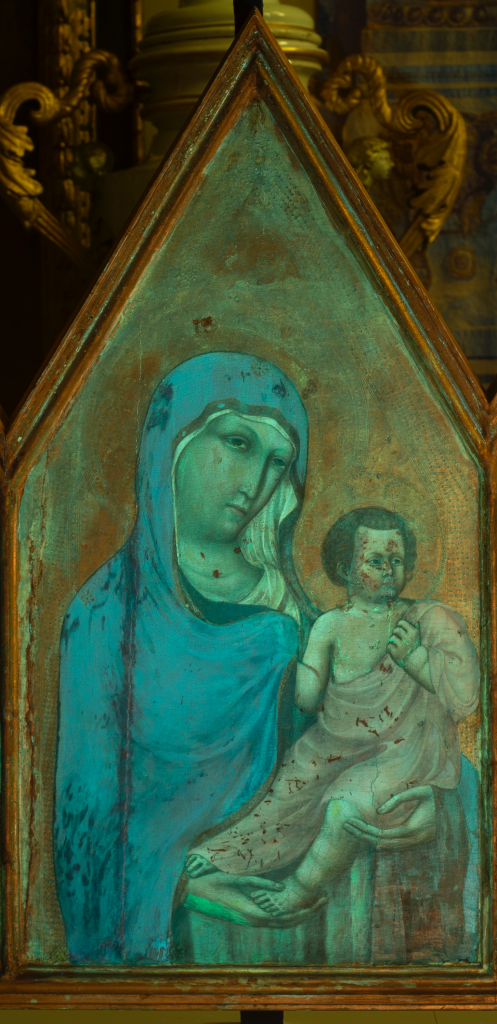
UV Imaging: Past art historians and conservators alike had proposed that the Virgin’s cloak might have been entirely over-painted, due to its flat and uniform appearance. UV examination showed more targeted areas of retouching, which appear as darker spots in the surrounding paint. Instead, we suggested that the flat appearance might result from past cleaning (see microscopic analysis below). Additionally, there are patches of blue fluorescence which suggest a natural varnish. A painting like this would traditionally be unvarnished. This varnish was almost certainly added at a later date, and the patchy remainders are further evidence of cleaning interventions.
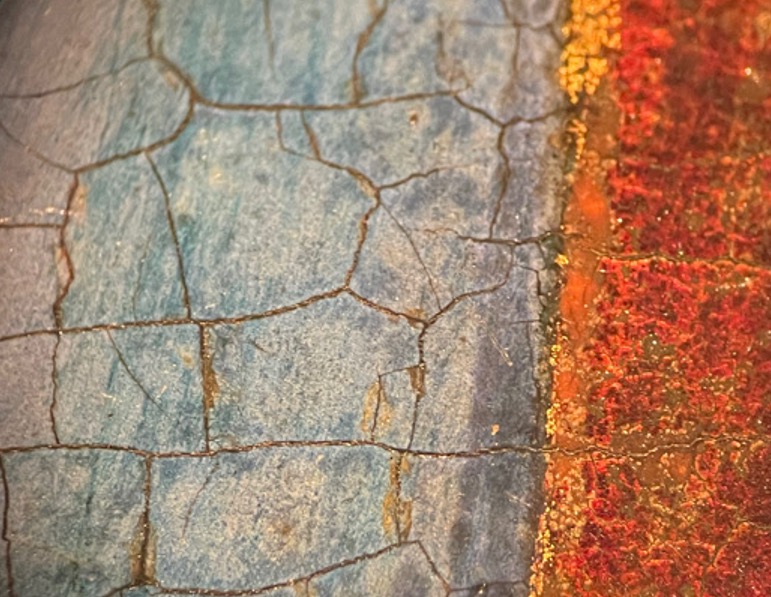
Under the microscope, evidence of a glaze of lapis paint, thicker and providing shading, was found only towards the edges, as seen in the image above. We concluded that this richer, blue layering must have originally extended across her cloak, but had worn away in past cleaning interventions.
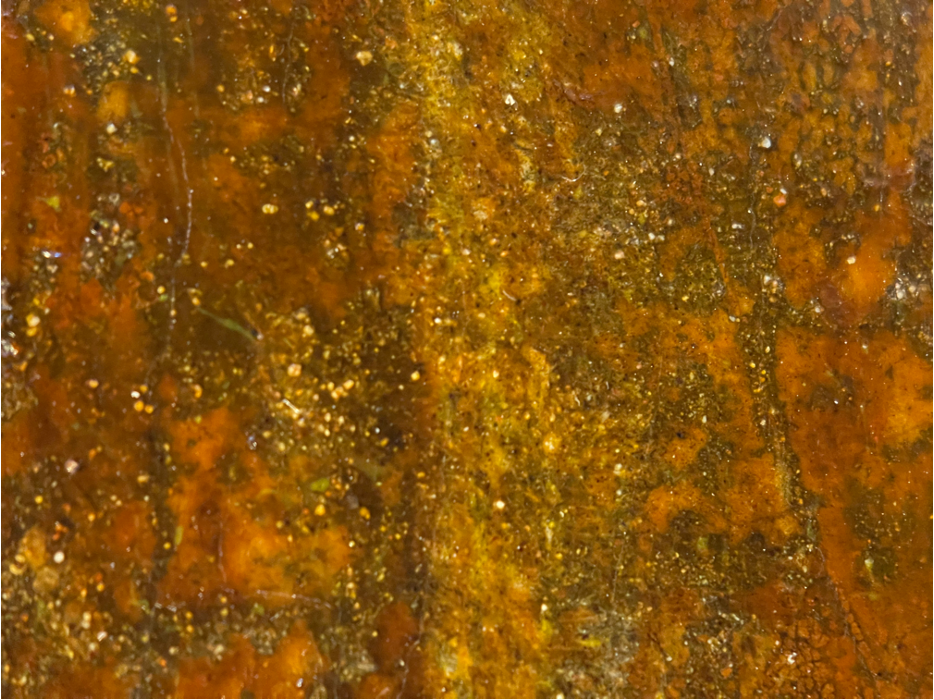
St. Peter’s cloak had an extremely mottled appearance, with a crusty gray surface over a red base layer. Traditionally, St. Peter would be clothed in yellow. Examination under the microscope, as seen above, showed distinct particles of a metallic gray substance. As a potential explanation, orpiment (or arsenic sulfide), is a naturally-occurring yellow mineral that has been known to degrade to a gray color. In this case, it might have reacted with the lead in the red lead paint below to form lead sulfides.
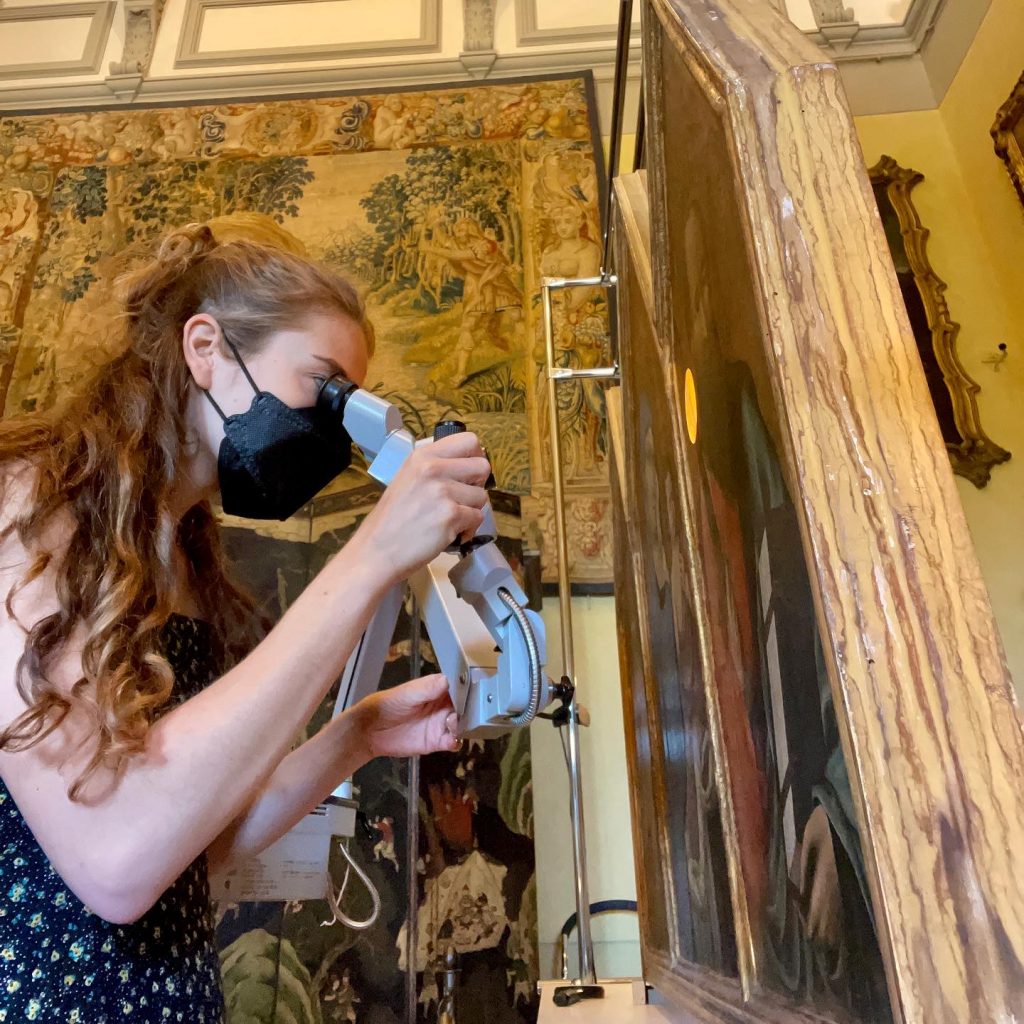
MICROSCOPIC ANALYSIS